May 17, 2025

In times of skilled labor shortages, companies face numerous challenges when searching for personnel, including intense competition, growing expectations of employers, and rising recruitment costs. Attracting and retaining qualified staff in the long term therefore requires efficient strategies. Employer branding can make a significant contribution here. In this article, we explain the importance of employer branding in recruiting and show you how you can increase your company's attractiveness as an employer through targeted measures.
The competition for talented employees is greater today than ever before. According to a survey by the ifo Institute – Leibniz Institute for Economic Research at the University of Munich, about 36% of companies in Germany were affected by the skilled labor shortage in February 2024. In this context, employer branding has established itself as an important tool for companies to stand out from competitors in the labor market. It represents an essential component of strategic recruiting.
But what exactly is employer branding, and how can it be efficiently implemented and executed in recruiting?
Employer branding encompasses the strategies and measures companies take to position themselves as attractive employers. A distinction is made between external and internal employer branding. Both areas influence the strength of the employer brand, but they involve different measures and target different audiences.
Internal employer branding aims to retain existing employees in the long term by creating a work environment in which they feel comfortable. Various measures are used to ensure that employees can identify with the company, are satisfied with their work, and therefore remain with the company as employees.
External employer branding optimizes the employer brand for potential applicants and the public. This is achieved through measures that relate to the company's reputation in the labor market. Consequently, external employer branding has a direct impact on the success of the recruiting process. For this reason, the following chapters focus on this form of employer branding.
However, internal employer branding also forms an essential foundation for sustainable recruitment: if a company's external image is appealing, qualified employees are found more quickly. If, upon starting their job, they realize that the actual internal conditions do not meet their expectations, there is a high risk that they will terminate their employment early. This would result in another time-consuming and costly recruiting process.
Furthermore, internal employer branding has a ripple effect on external perception. When employees speak positively about their work experiences, it strengthens the company's external image as an employer.
As already mentioned, the primary goal of employer branding in recruiting is to strengthen the company's image as an attractive employer in order to increase success in personnel recruitment. This overarching goal is divided into three sub-goals:
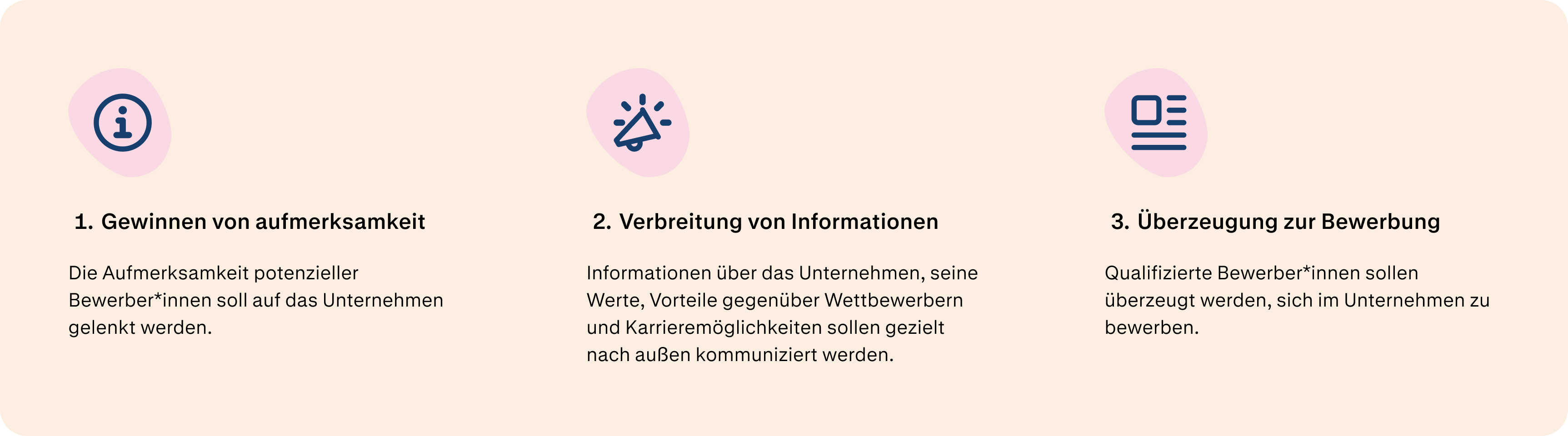
Successfully implementing employer branding measures and achieving the stated goals brings a multitude of benefits to the recruiting process.
One advantage is the increase in both the quality and quantity of incoming applications. A strong employer brand creates a positive image of the company, thereby increasing the incentive for candidates to apply. Furthermore, a positive employer brand leads to greater reach in the job market, making more potentially suitable candidates aware of open positions. Employer branding clearly communicates company values to the outside world, reaching potential employees who are a good fit for the company culture. As a result, applicants are already well-informed about the company, which generally leads to a higher level of compatibility between candidates and the organization.
If the company's external image aligns with the reality within the organization, it can be assumed that existing employees are satisfied and will recommend the company as an employer within their own networks. This can also generate applications from suitable candidates.
Furthermore, the increasing quality of applications can lead to a reduction in time and costs . Recruiters spend less time on the initial screening of applications because they are already better suited for the role. If candidates accept a position after the application process, their onboarding time may even be reduced, as they already possess the necessary foundational skills. This allows the company to reallocate the human resources required for onboarding to other tasks.
Employer branding is undoubtedly associated with numerous benefits. But even beyond that, it is simply essential for companies in many industries today just to remain competitive in the job market. While employers were once able to choose from a large pool of qualified applicants, it is now common for companies to have to fight to attract good employees.
In an era where qualified professionals are becoming an increasingly scarce resource, companies must position themselves as attractive employers to recruit staff and stand out against competitors. The labor market has shifted in favor of employees. The reasons for this are manifold. In addition to demographic change, technological progress is one of the factors causing a higher demand for specialized workers than are currently available.
To attract skilled personnel to your company, you need to build a strong employer brand. This is achieved through an employer branding process that consists of three steps:
1. Analyzing the current state: To determine the right measures, you must first define the company's current state. This involves examining various factors, such as corporate culture, employer attractiveness, and the recruitment process. The focus is on what defines the company in each area and sets it apart from others. These core characteristics are known as Employer Value Propositions. The more accurately the status quo is defined in this first step, the more effective the subsequent measures will be.
2. Developing an employer branding strategy: Based on the findings from the analysis, a concrete employer branding concept can be developed in the second step. This begins by defining what the employer brand should convey, including the values and benefits that will define the company as an employer moving forward. Defining the target audience is also a crucial part of a comprehensive employer branding strategy. This involves establishing the requirements candidates must meet and identifying the media channels through which they can be reached.
This step also involves deciding how the company should be presented to the target audience, specifically determining which information is most relevant.
Once these insights are gathered, employer branding measures can be decided. These may include entirely new approaches or adjustments to existing processes to meet the newly defined standards. To ensure the success of these measures can be measured later, you should also plan the goals you aim to achieve. Once both goals and measures are set, the concrete concept can be created. This includes all tasks that need to be implemented, along with a timeline for their completion.
3. Implementing the employer branding strategy: Finally, the defined measures must be integrated into the recruitment process. However, implementing an employer branding strategy is not a one-time task. To remain an attractive employer, continuous review and optimization of these measures are essential. Responsibility for integrating employer branding into recruitment varies depending on the company's size and structure. In smaller companies, these tasks are often handled by employees in HR or marketing. Larger companies sometimes have specialized internal employer branding managers or bring in external interim managers to help build the employer brand.
There are numerous measures you can apply to achieve your goals. These measures can be assigned to different phases of the recruitment process, which can be illustrated using a candidate journey. This shows the typical path a candidate takes from the moment they first notice the company until they become an employee:
During the pre-application phase, known as the awareness phase, the company's presence plays a major role. Candidates can only apply if they are aware of the company in the first place. Only in the next step do potential candidates research the company in more detail. Here, the quality of available information is of great importance. A job advertisement should contain all necessary basic information while also providing a good insight into the corporate culture. If the reader can identify with the values, they are more likely to apply. Highlighting the company's benefits can also strengthen the employer brand, provided they are meaningful and go beyond standard perks like "fruit baskets" or "on-time salary payments." Another possible measure at this stage of the recruitment process is creating an authentic social media presence that gives candidates a glimpse into the company's work culture.
During the application process itself, a smooth workflow is essential to reinforce the company's image as a progressive employer. In an era where simple online applications are the norm, obstacles in submitting documents can deter potential candidates and create the impression that the company does not value the candidate experience. Conversely, measures that ensure a seamless application process help candidates perceive the company as a modern employer that values its applicants.
In the subsequent selection process, the candidate has their first opportunity to gain a more detailed impression of the company during interviews. If this impression is positive, their desire to work for the company may increase. However, if the duration or the steps of the process are not communicated transparently, it can leave a negative impression. Implementing open communication regarding these aspects helps strengthen the company's image as a trustworthy and professional employer.
Establishing a strong employer brand for the long term requires more than just implementing a variety of measures once and hoping for the best. Only by continuously adapting your own processes and initiatives to the changing requirements of potential candidates can a company truly stand out from its competitors as an employer.
One factor that has become increasingly important in recent years is the growing awareness of sustainability. Many applicants are looking for companies that not only strive for economic success but also take on social and environmental responsibility. When a company projects a strong commitment to sustainability, it can significantly strengthen its employer brand.
The growing importance of remote work must also be integrated into your employer branding. With more and more companies offering flexible working hours and locations, candidates are increasingly seeking out these opportunities. Organizations that do not position themselves as flexible through their employer brand risk being overlooked by potential talent.
Furthermore, integrating remote work requires changes to the recruiting process itself. Convincing candidates of your company during online interviews requires a different approach than meeting them in person.
Once a strong employer brand is established, it brings many advantages to a company. However, building it is a lengthy and comprehensive process that can come with several challenges. To make your branding process effective, you should avoid the following mistakes:
1. Lack of authenticity: If a company's employer brand projects values that don't align with its actual culture, it can lead to negative consequences, such as higher turnover rates during the probationary period.
2. Lack of individuality: Adapting measures to the current needs of employees is part of the process. However, this often leads to many companies projecting the same image to the outside world. To stand out from competitors, companies should avoid generic, meaningless traits and instead represent their individual values.
3. Insufficient knowledge of your own employer brand: Before a company can build a strong employer brand, its own corporate values must be precisely defined. This is the only way to communicate the brand authentically to the outside world.
4. No adaptation to the target audience: More benefits or promises are not automatically more attractive to potential employees. They must be tailored to the target audience and offer added value to create an incentive to apply.
Failing to measure your results is another common mistake in employer branding. Only by regularly checking key metrics can you ensure that your chosen measures are effective and make adjustments where necessary. Particularly relevant KPIs in employer branding include:
1. Number of applicants: The total number of applications for open positions provides insight into how visible a company is as an employer in the public eye.
2. Number of offer acceptances: The number of employees who join the company after receiving an offer shows how a company's working conditions compare to those of its competitors. This includes factors such as pay, working hours, and benefits.
3. Cost-per-hire: This metric measures the total cost of recruiting a new employee. A strong employer brand can help lower this figure by increasing a company's appeal to potential candidates and encouraging applicants to proactively seek out open positions.
4. Time-to-Hire: This refers to the time required to fill a new position, starting from the publication of the job advertisement until a candidate is hired. A short time-to-hire
can indicate successful employer branding, as it shows that potential candidates see and respond to open positions quickly and that the recruitment process is efficient.
5. Source-of-Hire: This metric indicates which channels were used to recruit new employees. By determining which sources generate the most hires, resources can be focused more effectively on these channels and
ineffective channels can be reduced or optimized.
In the context of employer branding, the term recruitment marketing is also frequently mentioned. Both are human resources toolsthat pursue the same goal: generating applications and thus recruiting potential new employees. However, the two methods differ in both their focus and their approach to achieving these goals. As already explained, employer branding serves to build a positive employer image for a company. To this end, an employer brand is developed, maintained, and communicated externally. This is intended to improve the general perception of the company as an employer and thus increase the interest of potential applicants. Employer branding is therefore primarily strategic in nature.
Recruitment marketing, on the other hand, encompasses the implementation of direct measures to acquire new employees and thus constitutes the operational side of recruiting. The focus is specifically on filling certain open positions. Measures include, for example, publishing job advertisements that convey the messages defined during the employer branding process.
Accordingly, employer branding and recruitment marketing complement each other. A strong employer image created through employer branding can increase the effectiveness of recruitment marketing, as it boosts the company's attractiveness to potential candidates and facilitates the overall recruitment process. Conversely, successful recruitment through recruitment marketing activities can help to further strengthen the employer image.
Employer branding is essential for successful recruiting, especially in times of skilled labor shortages. It allows companies to position themselves as attractive employers and stand out from the competition. Through internal and external initiatives, companies can strengthen their employer image to increase both the quality and quantity of their applications, thereby attracting qualified employees.
Given the constant evolution of the working world and the changing needs of employees, it is essential for companies to adapt. With the rise of new work models, flexibility in employer branding is becoming increasingly important. Companies must respond to changes to maintain their competitiveness and attract qualified talent. Only through continuous review and adjustment of employer branding strategies will successful recruiting remain possible in the future, despite the shortage of skilled workers.
In einem unverbindlichen Gespräch tauschen wir uns gerne mit Dir zu Deinen HR-Themen aus und zeigen Dir, wie wir Dir bei diesen helfen können.
Florian Klages | Managing Partner


People analytics can contribute significantly to achieving corporate goals. In which areas can it be applied?