February 7, 2024

The importance of data in HR departments is growing continuously, with people analytics playing a key role. This HR tool allows for the use of diverse data sources to increase the effectiveness of personnel-related measures. Furthermore, it supports the development of successful strategies that contribute significantly to achieving corporate goals, including in recruiting.
Human resources has never undergone as much change as it is today. The effects of the COVID-19 pandemic are still clearly felt in 2023, New Work is transforming the labor market, and digitalization brings numerous challenges. One of the most dominant topics remains the shortage of skilled workers. While the number of unemployed people was nearly five million in 2005, the "war for talent" is now omnipresent. According to the Voices of HR study, many companies are currently struggling to position themselves as attractive employers and thus attract new employees. One solution that can optimize recruiting and is gaining increasing importance as part of the HR strategy is people analytics.
People analytics refers to the use of talent, organizational, and employee data with the goal of gaining insights that lead to informed decisions and positive business outcomes. The term is often used synonymously with HR analytics, talent analytics, or workforce analytics, although people analytics has a broader focus. It encompasses not only personnel management but also data from other areas of the company. When implemented correctly, people analytics can offer companies significant added value and contribute directly to business goals. For example, the use of people analytics can help identify patterns in employee behavior, allowing for a better response to employee needs. This can improve employee retention, which in turn can have a positive impact on employee engagement and company culture.
Examples of other topics where people analytics can help include:
• evaluating the effectiveness of HR programs,
• optimizing recruitment and selection processes,
• identifying skills gaps,
• evaluating employee engagement following initiatives,
• and developing strategies to reduce absenteeism.
People analytics generates great added value for HR departments. It provides essential data that can be highly useful for effective decision-making and serves as the foundation for a sound HR strategy that is optimally aligned with the company. Positive and negative developments within an organization can be better anticipated thanks to people analytics, and appropriate measures can be initiated in a timely manner. People analytics also plays an important role in process optimization. Here, the method can use data to show where processes are too cumbersome. Furthermore, people analytics makes employee data available more quickly.
Because while HR managers had to possess programming skills just a few years ago to access personnel data, information on topics such as salaries or desired qualifications can now be retrieved in just a few clicks using an HRIS (Human Resources Information System).
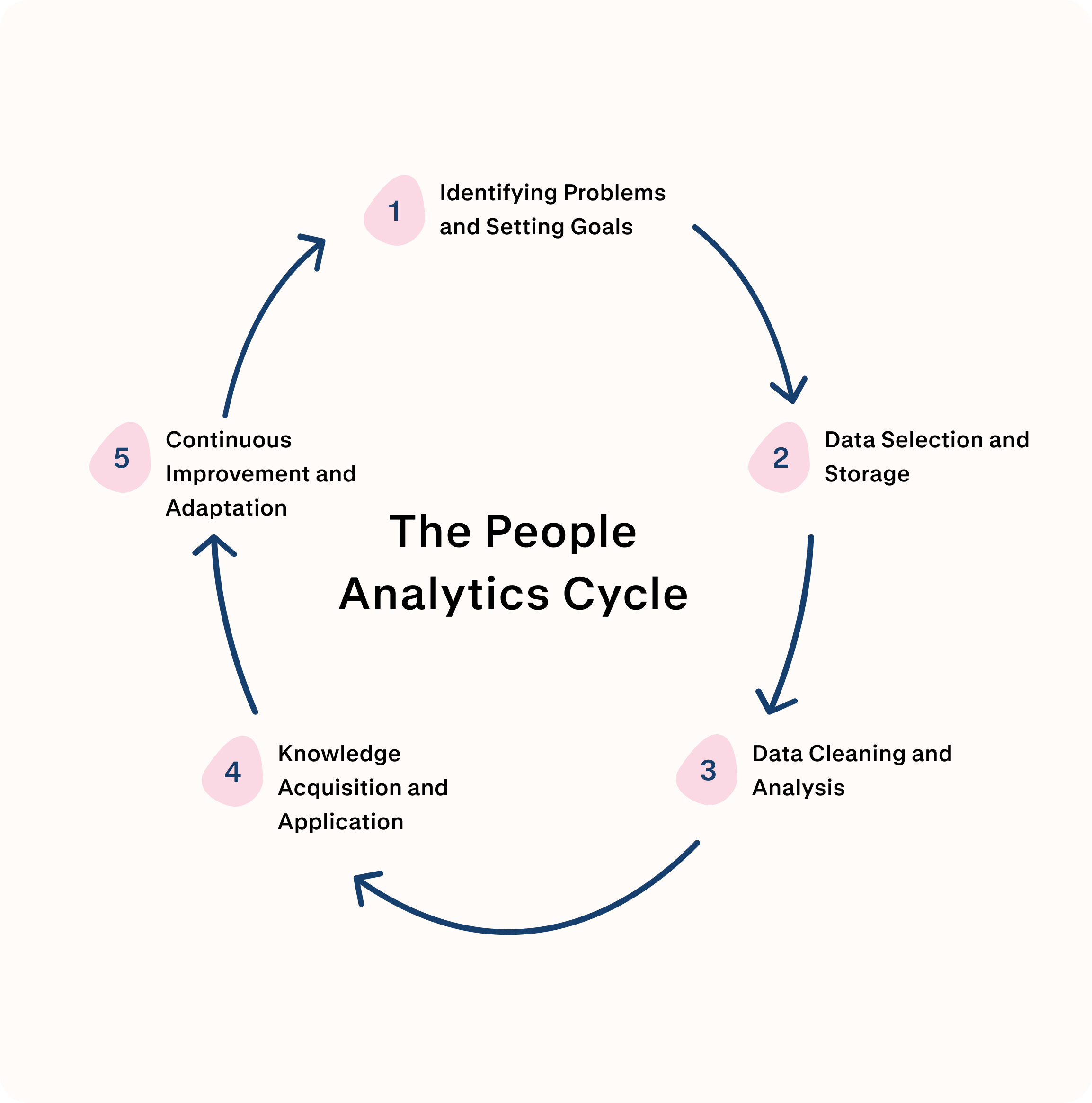
A People Analytics process typically involves the following steps:
1. Identifying problems and setting goals
For People Analytics to be successful, you must first determine exactly what you want to achieve. This begins by identifying the specific problems you intend to solve, such as weaknesses in the candidate selection process or issues with employee retention. It is important to define the problem as clearly as possible to facilitate data analysis. Subsequently, you must determine which data points to use and how they can contribute to potential solutions that are aligned with clearly defined business objectives.
2. Data selection
The second step centers on one main question: How do you obtain the data? Often, the data is already available, for example, in the form of HR data in annual reports or payroll systems. It can make sense to start by analyzing this existing data and using it to formulate initial hypotheses.
Regardless of the data you work with, data quality is paramount. An HRIS with a robust People Analytics module can provide a solution for a clean data foundation. However, even then, a flawless database is not always guaranteed, and the rule remains: complex data analysis based on poor data is a waste of time. The focus should always be on analyzing reliable, verifiable data.
3. Data cleaning and analysis
Once a usable data source is identified, the data quality must be verified. This is the only way to ensure that the final results are actionable. To maintain stable data quality, it is advisable to define which employees are responsible for updating HR data and to assign the appropriate user roles within the system. Before starting the analysis, you should also determine which datasets are relevant and define key performance indicators (KPIs). Only then can the analysis begin, using various statistical methods to identify patterns and trends.
4. Gaining and applying insights
The next step is to begin developing actionable insights. These should be used to optimize decision-making. Using a clear, intuitive dashboard can be highly beneficial here. You should also consider A/B testing to gather meaningful data that can be translated into recommendations and implemented by the company.
5. Continuous improvement and adaptation
The people analytics process does not end after interpreting the data and implementing improvement measures; it should be repeated regularly and systematically. This is the only way to keep track of developments within the organization and identify problems or opportunities. Furthermore, objectives, data sources, methods, and tools should be continuously reviewed and adjusted as needed to adapt to any changes in business goals, customer preferences, the technology landscape, or market conditions.
For people analytics to help solve challenges and increase employee performance, it is essential that the data and insights gained are integrated into the company's strategic planning and implementation. As previously mentioned, the accuracy, completeness, and consistency of the data used are also essential. It is equally important that the selected data is relevant. Only when data analysis provides practical value can it contribute to the company's business goals. It is also crucial that the HR team possesses the necessary analytical skills to interpret data correctly. When using data, meticulous care must be taken to ensure that data protection and security are considered in order to protect employee privacy and address ethical concerns.
For successful people analytics, close collaboration with the finance department is also recommended.
This makes it possible to better understand human resource costs, quantify the impact of personnel decisions, and ensure that the HR strategy is aligned with the company's strategy. Another essential point is proper implementation. This can be technically demanding and pose challenges for organizations, especially when various HR and corporate systems must be integrated to access relevant data sources. In most cases, investments in new software and employee training are required to close gaps in IT infrastructure and expertise. Finally, it is also important that the insights gained through people analytics are easily accessible and understandable for managers and the C-suite. This allows the department to receive the necessary support at the executive level. Managers often require training as well, so that analysis results can be interpreted correctly and sound conclusions can be drawn from them.
The applications of people analytics are diverse and can be found in a wide range of human resources areas. One of the most important applications of people analytics is in talent development. Here, people analytics helps, among other things, to identify the individual strengths and weaknesses of employees. This enables personalized training and development opportunities to fully realize employee potential.
Another area where people analytics is used is workforce planning, specifically in budget planning and headcount planning.
The method also plays an important role in performance management. With the help of people analytics, companies can define measurable performance indicators to evaluate and improve employee performance, track goal agreements, and assess employee performance using competency matrices.
Furthermore, people analytics enables the optimization of HR processes and the measurement of error rates, for example in sensitive areas such as payroll. It also supports capacity measurement and planning to ensure that HR teams are working effectively.
Other areas where people analytics can provide important support include health management as well as compensation and benefits. While analyzing employee health data can help develop and adapt health programs to promote the physical and mental well-being of employees and reduce healthcare costs, people analytics can assist in the design of compensation and benefits packages to develop competitive and fair pay structures that boost employee motivation and retention.
Another key application of people analytics is in the field of recruitment. By evaluating applicant information, companies can develop a deeper understanding of talent and better assess their suitability for a position. Instead of relying solely on traditional application documents, people analytics enables companies to perform data-driven pre-selection during the hiring process, where candidates are evaluated based on objective criteria. This makes it easier to identify suitable candidates and optimizes the selection process. At the same time, procedural weaknesses can be uncovered. According to a study by the management and strategy consultancy McKinsey, people analytics can increase recruiting efficiency by 80 percent.
Furthermore, companies can use people analytics to create more transparent recruitment and selection processes. Questions that can be answered through data analysis include: What skills are already present in the company? Which competencies are important for success in a specific position? The insights gained can be used to develop job descriptions that reflect the required qualifications and reduce mis-hires. In addition, this data can help companies better understand the development needs of their employees and offer more effective training programs. This can help reduce turnover.
People analytics is also a great support when it comes to measuring the effectiveness of individual recruiting channels. Various channels are used for recruitment, which can be evaluated using HR tools. Important KPIs include cost-per-applicant (the costs incurred to attract a new employee), cost-per-hire, and closings-per-source (the number of hires per channel). Measuring this so-called channel effectiveness makes it possible to determine which channels produce the best candidates and employees. Organizations can thus concentrate their resources more efficiently on the most promising recruiting channels and create the foundation to optimize costs-per-hire and build a reliable pipeline.
Data-driven solutions are playing an increasingly important role in attracting new employees. It is to be expected that in the not-too-distant future, people analytics will become a standard procedure for decision-making in human resources. This is hardly surprising, as the successful implementation of a people analytics strategy provides companies with a holistic understanding of their HR work. The method supports data-driven, objective decision-making processes and optimizes the acquisition and retention of employees, staff development, and many other processes. People analytics goes far beyond the visualization of data and can lead to higher productivity and profitability, thus making a decisive contribution to corporate success.
According to the auditing and consulting firm Deloitte, more than 70 percent of all companies surveyed in a study are investing in people analytics solutions to integrate data into decision-making and derive added value from available data. These investments indicate that people analytics is not just a passing trend, but an indispensable practice in modern human resources that helps companies make smarter business decisions and achieve better results.
In einem unverbindlichen Gespräch tauschen wir uns gerne mit Dir zu Deinen HR-Themen aus und zeigen Dir, wie wir Dir bei diesen helfen können.
Florian Klages | Managing Partner


The shortage of skilled workers is a problem for many companies. What opportunities does interim management offer to fill personnel gaps?

Many startups and SMEs outsource their payroll. When does outsourcing to specialized service providers make sense?