February 1, 2024

In times of skills shortages and advancing digitalization, companies are increasingly looking for flexible solutions to remain competitive. One popular approach is interim management, which provides companies with short-term access to personnel and expertise. Interim managers are also in high demand within the HR sector.
The market for interim managers is booming. To bridge capacity peaks in specialist and management positions or to act quickly during times of change, more and more companies are looking for temporary managers. With the exception of the slump during the 2020 pandemic, the demand for highly qualified interim support has risen steadily. According to the industry association Dachgesellschaft Deutsches Interim Management e. V. (DDIM), the market grew to 2.75 billion euros in 2023. Capacity utilization was at 91 percent in 2022, with even more potential in 2023. Small and medium-sized enterprises (SMEs), in particular, are increasingly seeking interim managers as corporate requirements grow and the skills shortage reaches the executive level. This also applies to human resources. HR interim management is a frequently used tool to meet the prevailing need for experts and executives.
Interim management refers to the temporary deployment of personnel, primarily in senior and middle management positions. Interim managers are hired by companies to support projects and tasks. They are primarily active during transition phases and therefore usually work on short- to medium-term goals. With their expertise, they relieve the burden on management and create new room for maneuver. Their deployment fills personnel gaps in companies and can stabilize team structures. Their assignments typically last between three and twelve months. A subsequent long-term employment, known as "try and hire," is the exception. The origins of interim management lie in the Netherlands, where it emerged in the 1970s and 80s. Companies in Great Britain have also been relying on the competence of interim managers for decades to efficiently address strategic and operational challenges.
These challenges arise, for example, when:
• your own employees lack the expertise for a specific project,
• they are absent for an extended period,
• they leave the company entirely,
• they are indispensable in day-to-day operations,
• or special situations such as turnarounds, restructuring, or acquisitions occur.
In their work, interim managers are constantly confronted with new challenges and must be able to solve diverse tasks effectively to bring about lasting positive change within a company. This requires extensive experience across various industries and company sizes, as well as a broad spectrum of skills. Only with these can they quickly grasp strategies and achieve results in a short time. Furthermore, companies expect interim managers to be unbiased and to bring innovation and creativity to the table. A study by Ludwig Heuse GmbH suggests that a large proportion of interim managers in Germany possess these skills and provide added value to companies after only a short onboarding period. According to the study, 80 percent of clients consider the risks that prompted the mandate to be contained after just 40 days.
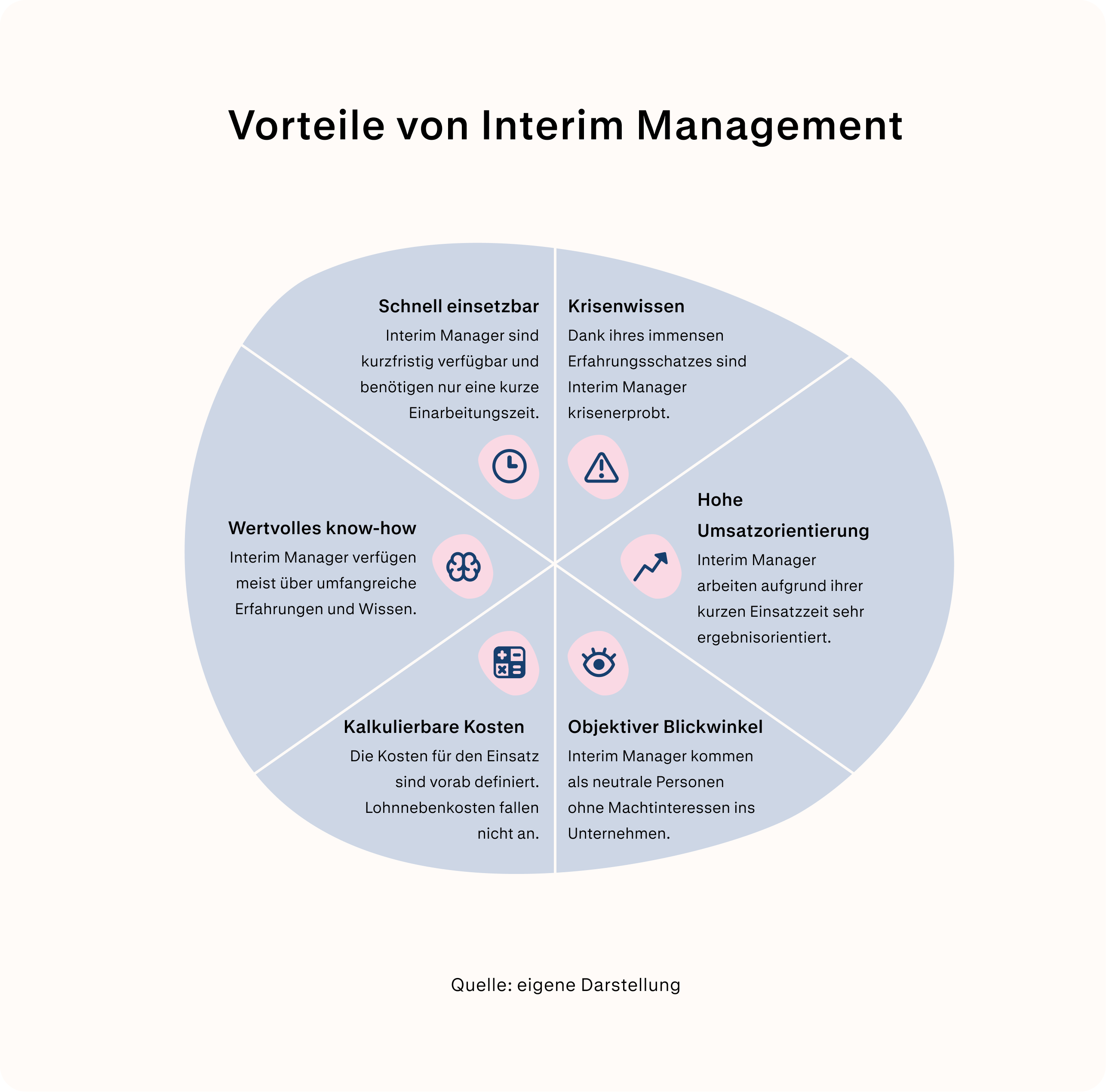
The costs for interim managers vary. Depending on the assignment, daily rates range between 700 and 2,500 euros. According to the recruitment consultancy EO Executives, the average in Germany is 1,052 euros. As a rule of thumb, the daily rate of an interim manager is roughly equivalent to one percent of the annual salary of an equally qualified permanent employee.
When evaluating the compensation of interim managers, it is important to consider that they are only paid for services actually rendered. There are no additional labor costs that would typically arise with a permanent hire. Furthermore, capable interim managers provide a return on investment (ROI) that far exceeds the cost of their work. Therefore, interim management does not necessarily have to be more expensive than a permanent position. Many companies that have opted for the services of interim managers once often become repeat clients.
One of the main reasons for hiring interim managers is that it has become increasingly difficult for companies to find qualified staff for open positions. This phenomenon, known as the skills shortage, is an acute problem for numerous companies across various industries. The reasons for this shortage are manifold. In addition to demographics, including a declining birth rate, the changing requirements for many roles due to digitalization and the resulting scarcity of qualified applicants play a decisive role. For companies, the skills shortage often represents a major challenge that can lead to an increased burden on existing staff and hinder productivity and innovation. The result is dwindling growth and, in the worst case, the loss of important clients or even the company's existence. According to the umbrella organization Deutsches Interim Management e.V. (DDIM), there is also a growing number of companies that need help filling leadership positions. The scarcity of skilled and management personnel means that more and more companies are seeking support from interim managers to bridge gaps in recruitment.
Interim management is a flexible and effective option for closing personnel gaps within a company. Due to the typically rapid availability of interim managers, vacancies can be filled at short notice, and the necessary expertise can be brought in-house to execute projects and stabilize team structures. Organizations do not have to wait for applications or initiate costly recruitment processes. This allows them to respond to challenges without significant delays. Thanks to their extensive experience and skills gained across various industries, interim managers can minimize recruitment bottlenecks in different functions and departments.
The skills shortage is also making itself felt in the HR sector. Many companies are trying to compensate for this by using HR interim managers. These are in high demand, particularly in the automotive, aerospace, and rail sectors, closely followed by mechanical and plant engineering, pharmaceuticals, medical technology, and healthcare. According to the educational platform Haufe, consulting firms and auditing companies also rely on temporary HR experts. Overall, according to Haufe, HR expertise is required in twelve percent of all interim management projects.
HR interim managers are experts who use their specialized knowledge to temporarily bridge gaps in HR skills and capacity, assisting with both operational tasks and strategic topics. The skills of HR interim managers are wide-ranging and, depending on their individual focus, cover the following areas:
• People Operations
• Recruiting and talent acquisition
• Tooling
• People analytics
• Project execution
• Change management
• Mergers & acquisitions
• Compensation & Benefits
• Payroll
• Crisis management
• Scaling
• HR tool implementation
• Negotiations
Beyond extensive expertise in one or more of the areas mentioned above, successful HR interim managers are distinguished by their ability to quickly build trust with new colleagues. This social skill is essential, especially in temporary HR leadership roles, to motivate employees for project tasks in a very short time. Since the extensive scope of duties often includes unpredictable issues, HR interim managers must also possess a quick and sharp grasp of new situations.
A common reason for hiring HR interim managers is to bridge vacancies. HR interim managers are also regularly deployed when there is a need for additional management or for project-based work. However, the majority of HR interim management mandates are in change management. Nearly half of all projects have this focus.
Change management deals with the implementation of measures intended to bring about profound changes within a company. This discipline is becoming increasingly relevant, particularly in the context of digitalization and the resulting shifts in customer habits, business models, and market structures.
When implementing a change process, it is crucial that leaders communicate strategy and execution clearly to employees. HR interim managers with professional and leadership expertise provide significant support here. Furthermore, they can use their skills to involve managers and specialists in the change process and compensate for a lack of internal know-how.
Interim managers are in higher demand than ever – including in the HR sector. In addition to advancing digitalization and technology, the primary reasons for this are the far-reaching consequences of the skilled labor shortage. Due to these factors, companies are increasingly forced to make adjustments to remain successful in the market. Experienced and professional interim managers offer organizations the ability to react quickly to changes and fill personnel gaps. Given the increasingly dynamic business environment, it is expected that the demand for interim managers will continue to rise in the coming years.
In einem unverbindlichen Gespräch tauschen wir uns gerne mit Dir zu Deinen HR-Themen aus und zeigen Dir, wie wir Dir bei diesen helfen können.
Florian Klages | Managing Partner


People analytics can contribute significantly to achieving corporate goals. In which areas can it be applied?

Many startups and SMEs outsource their payroll. When does outsourcing to specialized service providers make sense?