February 19, 2024

Payroll is an error-prone process that can quickly become a time-consuming and costly endeavor for startups and SMEs. It is no wonder that more and more companies are outsourcing their payroll. However, there are several things to consider. In this article, you will learn about the pros and cons of outsourcing and the options available to you.
For startups and other small businesses, the time-consuming task of preparing payroll often presents a challenge. After all, monthly processing involves a massive workload, and statements must be generated accurately and on time to comply with legal requirements. In Germany, for example, employees must receive their pay slips within two weeks of the end of the month. Furthermore, timely preparation can boost employee satisfaction, as it signals to staff that they can rely on being paid on time. To ensure payroll is processed without delays, companies should assign one or more employees to handle it. However, due to the complexity of payroll accounting and the fact that hiring a dedicated specialist is often not cost-effective, many businesses choose to outsource. This is especially true for startups, scaleups, and SMEs. According to the HR portal Personalwirtschaft.de, the main reason for outsourcing is the aging workforce in payroll accounting. Many of these professionals belong to the baby boomer generation. As they retire, there are often no successors, as few university graduates want to work in the payroll sector. Moreover, there is no specific training program for this at the university level.
Recent studies show that the outsourcing of payroll is on the rise. According to software provider SD Worx, payroll outsourcing was the third most frequently outsourced HR process in European companies in 2022. Only "HR process automation" and "legal compliance" were outsourced to external service providers more often. In the previous year, payroll outsourcing ranked eighth. Outsourcing payroll is particularly popular in Belgium. According to the study, only 26.7 percent of the companies surveyed there are willing to handle payroll themselves. Overall, the study shows that companies are becoming increasingly open to working with external partners, including for payroll processing.
But what exactly are the advantages that make outsourcing payroll increasingly popular? The most important arguments for outsourcing are listed below.
Cost savings
When payroll is outsourced, there is no need to hire a dedicated specialist, which would represent a significant financial burden, especially for young companies. Personnel costs such as social security contributions, additional costs for further training, and expenses incurred in the event of termination can be saved. There are also no costs for specialized software. In addition, an experienced service provider can optimize processes and thus increase efficiency. Even though outsourcing payroll involves costs, these services are usually cheaper than hiring an in-house payroll accountant for the reasons mentioned above.
Time savings
Outsourcing the process allows companies to focus less on time-consuming routine tasks like payroll and more on core competencies such as strategic initiatives. Especially when the founder or CEO is handling payroll themselves, outsourcing provides significant time savings in a critical area of the business. Accordingly, it often makes sense for startups in their early stages to outsource payroll. Furthermore, outsourcing reduces the bureaucratic burden for companies, as they only need to forward data such as working hours, holiday pay, and new hires or departures each month
.
Minimizing risk through expertise
Tax regulations and social security laws are constantly changing, and payroll legislation often has a shorter shelf life than other areas. Even before COVID-19, the growing number of payroll regulations was a challenge for many companies. During the pandemic, the government passed laws at a rapid pace, further complicating the situation. Consequently, the skills of internal staff are often pushed to their limits. A specialized service provider has the expertise to meet the requirements of the tax authorities and can handle payroll quickly and reliably. This allows companies to minimize the potential for errors and risks, avoiding penalties and back payments for incorrectly prepared statements.
Training and consulting
At the same time, permanent staff often gain valuable knowledge from qualified service providers, keeping them up to date with any legislative changes. For questions and complex issues, the service provider can also offer expert guidance and determine the most effective solution for the company.
Cost transparency
Payroll services can be clearly budgeted, as external providers present their pricing models and rates in advance. This makes it easy to calculate the costs of outsourcing beforehand. As a result, the company retains full control over costs, reduces fixed expenses, and preserves liquidity.
While there are clear benefits to outsourcing payroll, there are also some disadvantages that should be considered during the decision-making process.
Dependency
Working with a payroll or tax firm creates a certain level of dependency on the external provider. This can be due to long-term contracts, but it also means that by outsourcing, companies rely on the provider's expertise, which risks the erosion of internal knowledge. However, since service providers often share their knowledge with internal staff, this is only a minor concern.
Liability
While the service provider is responsible for the correct execution of payroll, the primary responsibility usually remains with the client, and the company can be held liable for issues such as the incorrect transfer of payroll and operational data. However, by choosing an experienced service provider who is up to date with the law and familiar with all payroll details, the liability risk can be significantly minimized.
Loss of control
Service providers gain insights into internal operations and confidential data as part of their work. For companies, this implies a partial loss of control, particularly regarding data security. After all, the risk of an external service provider disclosing internal data can never be completely ruled out. However, since service providers based in Germany are required to work strictly in accordance with German data protection guidelines and standards, this loss of control is rarely a problem for companies. It is important that companies, when choosing a service provider, ensure that they adhere to the security certificates of the Federal Data Protection Act and are ISO 27001 certified (the security standard for information security management systems).
Misunderstandings
If communication between the client and the service provider is not seamless, delays and errors can occur. This potential disadvantage can be avoided if requirements are clearly communicated to the service provider.
There are various options for outsourcing payroll. For example, the process can be outsourced to tax firms. As experts in tax matters, tax advisors usually possess comprehensive knowledge of the legal requirements for payroll accounting. Another option is outsourcing to an accounting firm. These firms can generally handle various financial and accounting tasks, including payroll. Other service providers, such as HR consulting firms and freelance payroll accountants who offer corresponding services, are also popular choices.
In addition to outsourcing payroll to an external service provider, companies also have the option of handling payroll using payroll software. While this is not outsourcing, external service providers can still play an important role here by helping to optimize internal company processes using appropriate tools.
If a company decides to outsource its payroll accounting, it should also pay attention to the service provider's digital expertise. Competent and consistent points of contact, as well as a transparent contract, are also important.
In principle, cost transparency and cost savings are among the cited benefits of outsourcing. However, since the pricing models of accounting firms and tax firms differ, the amount of savings depends on who the payroll is outsourced to.
For tax advisors a flat monthly base fee or a per-employee fee is standard. When setting prices, tax firms are subject to guidelines set by the Tax Advisor Remuneration Ordinance, though they have some flexibility in implementation. Their prices relate to the ongoing, recurring tasks required monthly for each employee's payroll. Additional flat fees apply for extra work, such as registering new employees. Furthermore, a one-time setup fee is charged at the start of the service. Depending on the size of the company, the number of employees, and the scope of the service, total monthly costs can amount to several hundred euros.
Unlike tax advisors, payroll bureaus as private companies are not subject to direct legal requirements regarding their pricing. Therefore, costs can vary between different external payroll accountants. It is common here to structure prices into different service packages or to tier them based on the number of employees. Overall, these costs are on average lower than those of tax advisors.
The most cost-effective option for companies is implementing accounting software. This incurs monthly usage fees that vary depending on the program and the number of employees. These usage fees are usually significantly lower than the regular fees charged for the services of payroll bureaus or tax advisors. However, it must be noted that in addition to the supposedly lower costs, internal personnel costs are incurred in connection with the management and maintenance of the software.
Once all criteria have been weighed and an external service provider has been selected, the outsourced payroll process begins. Whether you choose a tax consultancy or a payroll office, the workflow consists of the same three steps:
1. Preparing for external payroll: First, the company must transmit all relevant payroll data to the external service provider. This includes employee master data, salaries, and working hours, among other things. Internal guidelines regarding deadlines should also be taken into account at this stage. Once this information is collected, the payroll system can be set up. This step is only performed once at the beginning.
2. Generating payroll: Once all data has been entered, payroll is generated on a monthly basis, with the service provider taking into account both the internal guidelines provided and legal requirements. It is important that the company keeps the service provider up to date on any changes that affect payroll. The format and frequency of these updates can be agreed upon individually between the parties.
3. Electronic data transmission to the relevant authorities: Following this, the tax consultant or payroll accountant handles the data transmission in accordance with the Data Collection and Transmission Ordinance (DEÜV). This includes timely reporting to social security institutions and the tax office. Just like step 2, this task is repeated monthly.
These three steps cover the entire payroll generation process. Depending on the agreement, however, the service provider can also take on additional tasks within the internal payroll process. The payroll process includes the following steps:
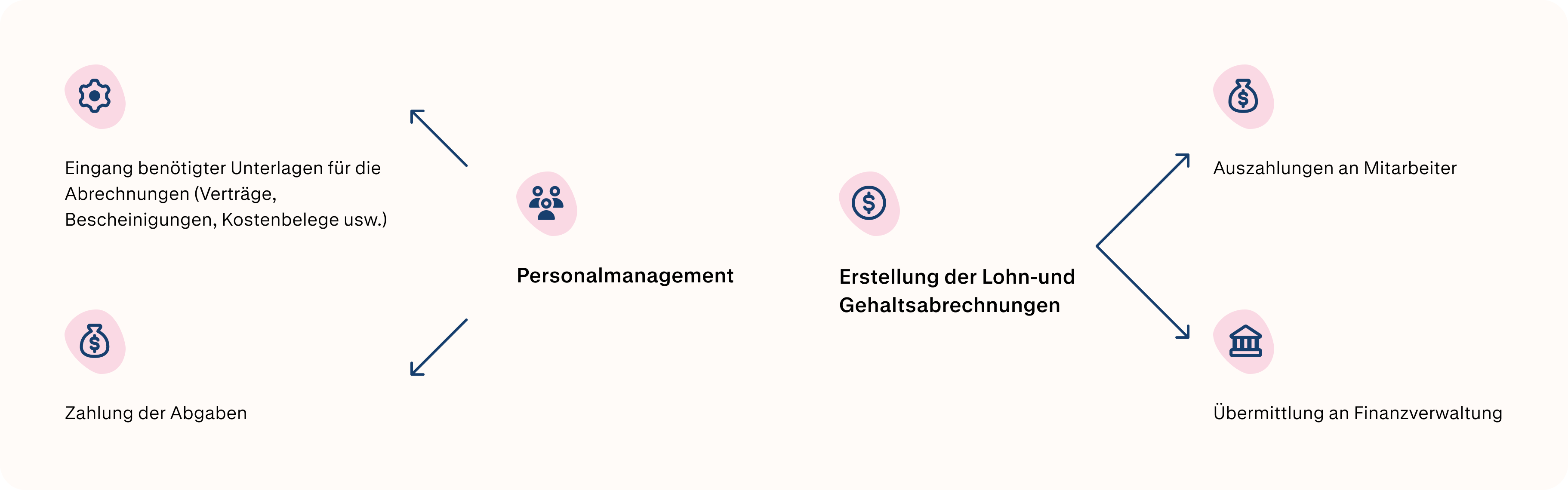
If payroll is outsourced to an HR consulting firm, the process differs from the one described above. In this case, the company's initial situation is first analyzed to define the need for support. To complete the identified tasks and implement planned measures, the consulting firm places an interim accountant within the company.
An interim accountant is a specialist hired on a temporary basis to relieve the internal accounting department, fill staffing gaps, or optimize the payroll department using their expertise. Initially, they are introduced to the company's existing payroll processes and, after onboarding, begin implementing the planned measures and handling ongoing tasks. Throughout the temporary assignment, the consulting firm remains available as a point of contact. They consult with the company on the extent to which the external accountant is meeting the established goals.
If there is still room for improvement, the scope of the assignment is adjusted accordingly.
Outsourcing payroll to external service providers can be done in just a few steps. However, in an era where artificial intelligence (AI) is becoming increasingly important across many fields, one must ask to what extent payroll processing will even require human involvement—internal or external—in the future. Will the capabilities of AI eventually allow for fully automated payroll accounting? If so, would outsourcing still offer any real value?
Traditional payroll software has primarily relied on fixed algorithms. This makes it highly reliable for calculating basic salary components, such as overtime, taxes, and social security deductions. However, it lacks the flexibility to adapt independently to dynamic billing options or changing legal requirements. In this regard, traditional software differs significantly from AI-based solutions in terms of scope and performance.
AI systems can do more than just process payroll; they can understand and analyze the complex data involved. If they detect errors or irregularities, they can correct them. The same applies to violations of current laws or regulations. Furthermore, such software identifies patterns and relationships, enabling it to determine the root causes of issues, counteract them, and thereby increase the overall efficiency of the payroll process.
To reap these benefits, however, companies face additional effort when implementing an AI program. First, the employees responsible for payroll must be trained in AI. Additionally, it must be ensured that the chosen software complies with data protection guidelines. Since payroll contains sensitive employee data, strict requirements must be met to guarantee confidentiality. Violations of data protection regulations can lead not only to legal consequences but also to a loss of employee trust—especially if external parties gain access to personal data through cyberattacks. Therefore, it is essential that the chosen AI software is regularly audited to identify and fix potential security vulnerabilities. Overall, it is expected that AI systems will become increasingly important in payroll processing in the future. AI can take over many payroll tasks, freeing up time for employees to focus on strategic work. Nevertheless, human expertise will remain necessary to monitor AI activities, ensure the security of the chosen program, and make informed decisions in unique cases. These are all tasks that experienced service providers can also handle. Tax advisors or payroll offices that already possess comprehensive expertise in AI can simplify the implementation process for companies and ensure efficient use.
Payroll is a self-contained process with few overlaps with other company functions, making it relatively easy to outsource. By outsourcing this complex task, a company can dedicate more focus to its core business. Whether outsourcing is worthwhile is a decision each company must make individually. The same applies to the question of how and to whom the payroll process should be outsourced, as the scope of the aforementioned pros and cons can vary depending on the chosen method. For very small companies, for example, it may make more sense to handle payroll using software. In principle, however, any company that cannot or does not wish to hire internal payroll specialists can benefit from outsourcing. In the future, both external service providers and AI-supported systems will offer companies increasing support in payroll preparation. However, a payroll provider cannot solve internal company problems, such as those related to HR processes; these require a more comprehensive consulting approach.
In einem unverbindlichen Gespräch tauschen wir uns gerne mit Dir zu Deinen HR-Themen aus und zeigen Dir, wie wir Dir bei diesen helfen können.
Florian Klages | Managing Partner


The shortage of skilled workers is a problem for many companies. What opportunities does interim management offer to fill personnel gaps?

People analytics can contribute significantly to achieving corporate goals. In which areas can it be applied?