September 16, 2024

A well-established feedback culture can have a positive impact on organizational success. It not only fosters individual employee growth but also contributes to the development of the entire company. In this article, you will learn how to establish an effective feedback culture, what other benefits it offers, and how you can continuously improve it.
In a 2023 Cubia study, 59 percent of surveyed employees stated that receiving regular feedback on their performance is important or very important to them. Being able to provide feedback themselves is also a high priority for 66 percent of respondents. According to the 2024 Netigate Benchmark Study, when employees are periodically given the opportunity to share their feedback, it has a positive effect on employee engagement within the company.
A two-way feedback flow—from managers to employees and vice versa—can therefore have a major impact on employee satisfaction. However, according to the benchmark study, this potential remains untapped in many companies: only 50 percent of surveyed employees have the opportunity to provide feedback at least once every six months, while 20 percent have no opportunity at all. Furthermore, 44 percent of respondents do not receive regular feedback from their managers, making it difficult for them to assess their own performance and meet expectations. Given current challenges like the skills shortage, it is becoming increasingly important for companies to develop a feedback culture that meets the needs of all stakeholders. This is the only way for organizations to attract, motivate, and retain employees in the long term.
A feedback culture refers to the atmosphere within a company that encourages the exchange of mutual assessments. In a positive feedback culture, both employees and managers are encouraged to create transparent communication where constructive criticism and praise can be expressed openly. This can contribute not only to the continuous optimization of company processes but also form the foundation for successful performance management—the targeted steering and development of employee performance. After all, sustainable employee development can only be achieved through clear communication about what is going well and where improvements are needed.
The core of any feedback culture lies in how feedback is exchanged and utilized. To achieve improvements through feedback, it should be implemented according to a consistent framework. This process can be illustrated by a feedback loop consisting of five steps:
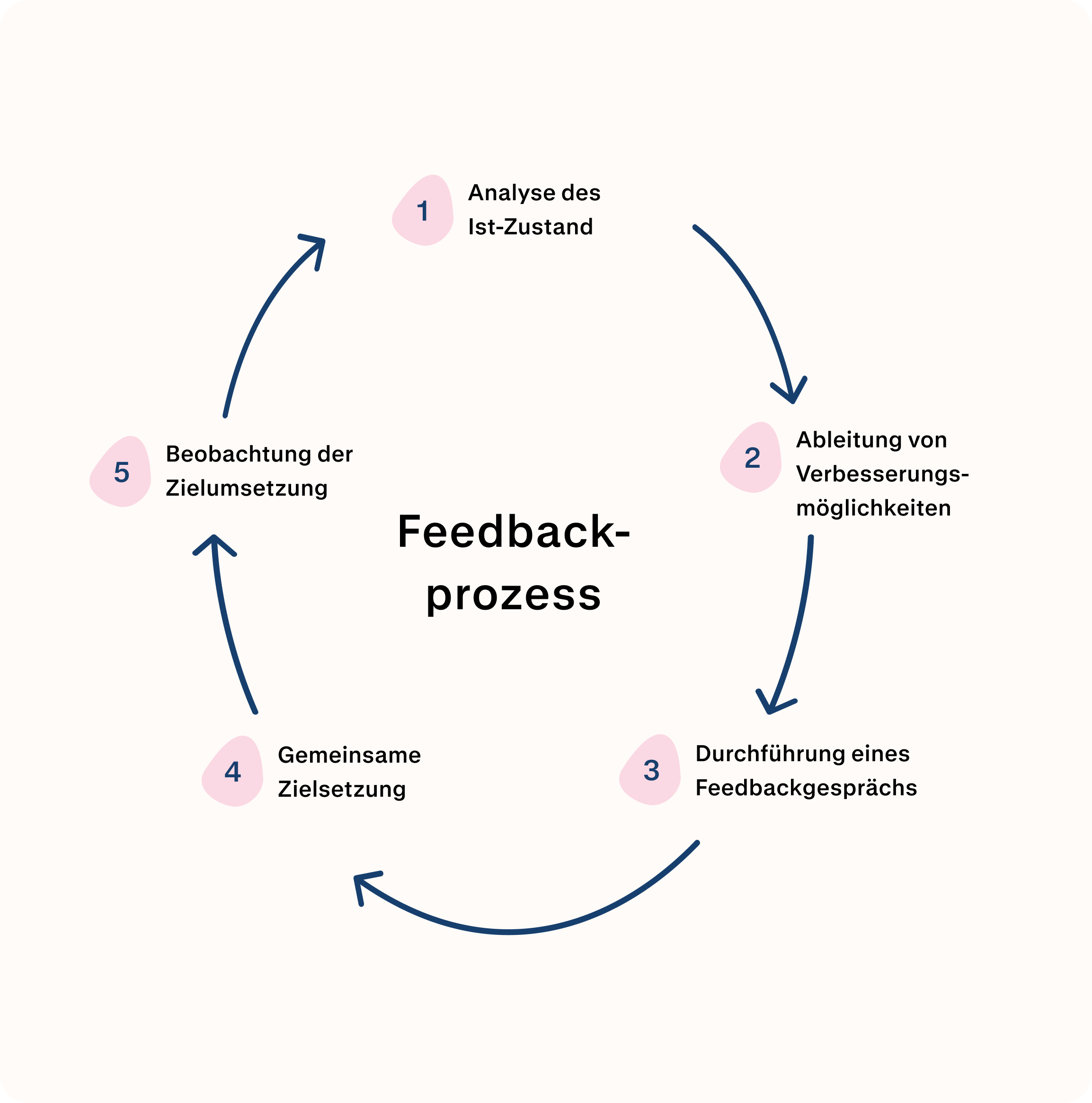
The exact design of the feedback loop depends on the chosen method of gathering feedback. There are four types, each incorporating a different number of perspectives. 90-degree feedback combines a self-assessment with feedback from one other person, usually a manager. No further perspectives are included in the assessment. This form of evaluation can be conducted by a manager for an employee or vice versa. 180-degree feedback, on the other hand, is used exclusively for evaluating managers, as it involves assessment by the manager themselves, their direct supervisor, and a subordinate. 270-degree feedback expands on the 180-degree model by adding feedback from colleagues at the same hierarchical level. An even more comprehensive variant is the 360-degree method. Here, everyone who works with the person being evaluated has the opportunity to provide feedback. In addition to colleagues, this can also include customers.
Whether it concerns individual processes, employees, or the entire company, a feedback culture can improve performance when implemented effectively. Specifically, establishing a feedback culture offers the following benefits:
Strengthening employee retention: In a positive feedback culture, regular feedback shows employees that their performance is valued and recognized. The opportunity to provide their own feedback in return demonstrates that their opinions and ideas matter. When employees feel heard and appreciated, their job satisfaction and commitment to the company increase. When employees convey this sentiment externally, it can make an organization more attractive to potential new hires.
Employee development: A feedback culture serves as a tool for employee development. Regular feedback provides employees with an overview of their performance. It allows for the creation of individual development plans: strengths can be specifically nurtured and weaknesses addressed to boost performance. This helps employees achieve their career goals and increases their motivation, which in turn can enhance their contribution to the company's success.
Conflict prevention: When feedback is provided regularly and constructively, misunderstandings and tensions can be identified and resolved early on. This increases mutual trust, which contributes to a more harmonious work environment while strengthening team spirit.
Generating ideas: An open feedback culture can foster innovation within a company. When employees know their feedback is taken seriously, they are more motivated to contribute their own suggestions for improvement. The exchange of ideas increases the likelihood of finding innovative solutions that move the company forward.
To ensure that a feedback culture is embraced and implemented by all employees, its establishment should be well-prepared and carried out step by step:
1. Planning and goal setting: Since there are different approaches to implementing a feedback culture, a guideline must first be created. This defines the goals to be achieved by introducing a feedback culture. Based on this, decisions are made regarding which feedback collection methods will be used, how frequently feedback will be exchanged, and which tools will be employed. Additionally, it is decided who will be responsible for the implementation.
2. Communication: Next, the planned processes are communicated to the employees. This can be done through various channels such as meetings, newsletters, or internal platforms. To increase openness to change, it should be explained transparently why changes are being made and what benefits they bring to both the employees and the company. New employees should be familiarized with the processes from the start by integrating the feedback culture into the onboarding process.
3. Training: To effectively implement the planned feedback culture, all employees and managers should be trained on the topic of feedback beforehand. These training sessions can cover, among other things, how to communicate feedback constructively and purposefully to ensure it fulfills its intended purpose and has a lasting impact.
4. Implementation: Once all preparations are complete, the plan established at the outset is put into practice in daily operations. Fixed routines for exchanging feedback are established, and their consistent implementation is monitored. To ensure that a feedback culture is sustainably anchored within the company, the development of an open and trusting communication atmosphere must be fostered in parallel.
Even if the establishment of a feedback culture has been well planned in advance, various challenges can arise during implementation. One hurdle can be a lack of willingness on the part of employees and managers to engage with a new feedback culture. After all, the regular exchange of assessments requires not only a change in communication habits but also an open attitude toward feedback. Not everyone feels comfortable with the idea of being evaluated. Therefore, it is important that employees and managers recognize that constructive criticism offers an opportunity for further development.
Rigid hierarchies can also pose an obstacle, as employees may feel uncomfortable openly criticizing their superiors. They might fear negative consequences or that their feedback will not be taken seriously. In addition, some companies lack an atmosphere where criticism can be expressed openly. If employees feel that honest feedback could lead to conflict, they often hold back. To overcome these barriers, a safe environment must be created where constructive criticism can be voiced without hesitation.
The time required can also be a challenge. While initial preparations can be completed in a few weeks, it can take years for feedback structures to be consistently applied and accepted by all employees. During long transition phases, there is a risk that existing feedback practices will continue to be used, which can lead to inconsistent application of a new feedback culture. For a feedback culture to be effective, however, it must be consistently implemented across all areas of the company.
To ensure a strong feedback culture in the long term, processes must be regularly adjusted. As a basis for this, the effectiveness of the current feedback culture is first measured. In this way, weaknesses can be identified and targeted optimization measures can be derived.
One way to evaluate existing processes is to conduct feedback loops. For this purpose, as many people involved in the processes as possible provide an assessment of the feedback procedures. This can be done, for example, by participating in surveys or interviews. The collected feedback is then analyzed to gain an assessment of general satisfaction with the feedback culture and to derive opportunities and risks. Depending on the form of the survey, the responses can also directly identify specific weaknesses or potential for optimization.
In addition to feedback loops, the quality of feedback cultures can also be measured using key performance indicators. Relevant indicators include, for example, the frequency of feedback sessions, employee satisfaction with the feedback received, and the number of improvement suggestions implemented. Regular monitoring of these metrics makes it possible to identify trends and react to negative changes at an early stage. This allows a company to determine whether its feedback culture is not only being practiced but is also actually contributing to improved company performance and increased employee satisfaction.
Based on the insights gained, concrete optimization measures are then developed. Possible courses of action include:
Establishing feedback guidelines: To ensure that feedback is both appreciative and constructive, you can establish binding feedback guidelines. These define how feedback should be formulated and delivered so that it is well-received and contributes to professional growth. Because these rules apply consistently to everyone and provide a framework for communication, they help minimize misunderstandings. The following rules can improve your feedback process:
- Criticism should always be paired with concrete suggestions for improvement to ensure it is goal-oriented.
- Use "I" statements when giving feedback to ensure it does not sound accusatory.
- Good feedback should always include both praise and criticism to provide motivation.
- Criticism must always be expressed objectively and fairly so that it remains constructive and is perceived as helpful by the recipient.
- Both parties should listen carefully to one another to ensure that all perspectives are fully understood.
- Feedback should be clearly formulated, ideally with examples, to avoid misunderstandings.
Implementing alternative methods: Another way to optimize a feedback culture is to incorporate different perspectives. If the focus has previously been on top-down feedback—from managers to employees—introducing bottom-up feedback, where employees provide input to their managers, can improve the culture. Additionally, horizontal feedback, which involves peer-to-peer exchanges, can strengthen team dynamics and encourage the sharing of experiences. Comprehensive methods, such as 360-degree feedback, allow for a holistic assessment by combining input from all perspectives.
Changing the feedback channel: If a feedback culture is not being used effectively despite thorough implementation, the chosen channel may be the issue. Using digital feedback tools makes it quick and easy to collect input, which lowers the barrier to participation. If feedback has previously been limited to formal meetings, switching to more informal channels—such as regular, brief check-ins or anonymous surveys—can help employees feel more comfortable communicating honestly, especially when it comes to sensitive topics.
Increasing the frequency of feedback: Another approach to improving a feedback culture is to shorten the intervals between feedback opportunities. More frequent feedback allows employees to respond to criticism faster and continuously improve their performance. Furthermore, it keeps managers and employees better informed about progress, which increases the efficiency of their collaboration.
For feedback culture optimizations to be effective, they must be adapted to the needs of the employees. A generational shift is currently taking place in the labor market: Generation Z, born between 1995 and 2010, is entering the workforce. This generation grew up entirely with the internet and social media, which is why they are often referred to as "digital natives." Digital natives not only possess strong digital skills but also have different expectations of the working world compared to previous generations.
A Statista survey shows that a strong feedback culture plays a paramount role for Generation Z in a professional context. 52 percent of respondents stated that appreciation and praise from managers are particularly important to them. Furthermore, 43 percent expect openness and a willingness to change from their supervisors. This highlights Generation Z's desire for their ideas and suggestions for improvement to be heard and taken seriously, as well as their wish to be actively involved in company development.
Additionally, having grown up with social media, Generation Z is accustomed to receiving immediate feedback. At the same time, they place great importance on advancing their careers quickly. A survey by Continental illustrates that this aspect plays a larger role for Generation Z than for other generations currently in the labor market. Consequently, they often expect continuous feedback on their performance in a professional setting so they can develop faster and achieve their career goals.
A rigid feedback culture based on annual performance reviews no longer meets these expectations. Instead, the modern working world requires an agile feedback culture that is flexible enough to address the needs and demands of a diverse workforce. Even feedback cultures that are already delivering positive results within a company should be reviewed regularly. This is the only way to ensure long-term added value.
Establishing a strong feedback culture is currently more important than ever. Especially in times of crisis, developing an effective feedback culture is far more than just an organizational necessity. It can have a major impact on business success by boosting innovation and strengthening employee retention in the face of skills shortages. Furthermore, the generational shift in the labor market requires a rethink of how feedback is given and received.
Currently, some of Generation Z are still in university or vocational training. In 2022, about 44 percent were employed full-time and 16 percent part-time. Although they currently make up a relatively small share of the labor market, their influence will increase significantly in the coming years. This generation has requirements for feedback processes that differ significantly from previous expectations. Likewise, subsequent generations, who are growing up with even more advanced technologies and changing value systems, will have different demands for feedback processes.
The share of older generations who entered the workforce before the digital age and are accustomed to rigid feedback processes is shrinking. Companies must therefore adapt their feedback culture early on to meet the needs of future generations. A modern, flexible feedback culture will be fundamental in the future to remain competitive despite a changing labor market and to attract and retain new employees both today and in the future.
In einem unverbindlichen Gespräch tauschen wir uns gerne mit Dir zu Deinen HR-Themen aus und zeigen Dir, wie wir Dir bei diesen helfen können.
Florian Klages | Managing Partner


Employer branding can support your company in its search for personnel. What are the benefits, and how do you develop a suitable strategy?

People analytics can contribute significantly to achieving corporate goals. In which areas can it be applied?