October 23, 2024

In a highly competitive labor market, the speed at which organizations can attract new talent can have a major impact on business success. A short time-to-hire makes it possible to react quickly to changing staffing needs, prevent employee burnout, and stand out positively from competitors as an employer. In this article, you will learn which factors influence the time it takes to fill a position and how you can reduce this duration.
According to statistics from the Federal Employment Agency (BA), the average vacancy time—the time it takes to fill an open position—has been rising continuously in Germany since 2010. While the period between the desired start date and the final notification of a filled position averaged 57 days in 2010, it reached 102 days in 2017. From October 2023 to September 2024, the average vacancy time reached a record high of 158 days. In so-called bottleneck professions, this period can be even significantly longer: according to a BA survey, interior finishing and drywall construction have the longest average vacancy time at 302 days.
Long vacancy periods not only have a negative impact on company performance but also incur significant costs. According to a study by Stepstone, these costs averaged 49,000 euros per unfilled position in 2023.
With optimization measures, vacancy times can be shortened, thereby reducing costs. From improving application processes and using digital tools to strengthening your employer brand—we will show you what changes you can make to accelerate your recruitment process.
Time-to-hire is a metric that measures the time it takes to fill an open position. However, the exact interpretation of the term varies. If companies rely on the narrower definition, it refers to the period from the application of a suitable candidate to the hiring, which is usually defined as the signing of the employment contract. In the broader definition , time-to-hire begins when recruitment starts. This usually coincides with the posting of a job advertisement. The end point here is also the day of hiring.
The following refers to the broader definition. This is because delays in the early stages of a recruitment process, such as generating applications, can sometimes have the same negative effects as delays in the selection process or decision-making. Therefore, adjustments are also necessary in the early phases of time-to-hire to achieve the best possible optimization.
Two other metrics that are frequently listed in the context of filling positions are time-to-fill and vacancy time. Both differ from time-to-hire in the period they cover. Time-to-fill starts, like the broad definition of time-to-hire, with the beginning of a recruitment process, but only ends on the new employee's first day of work. Vacancy time is recorded by the Federal Employment Agency (BA) and describes the period from the desired start date for a position to the point when the vacancy is reported as filled to the BA.
Time to Hire is divided into several phases, the tasks of which can vary depending on the specific recruitment process within a company. It typically includes the following steps:
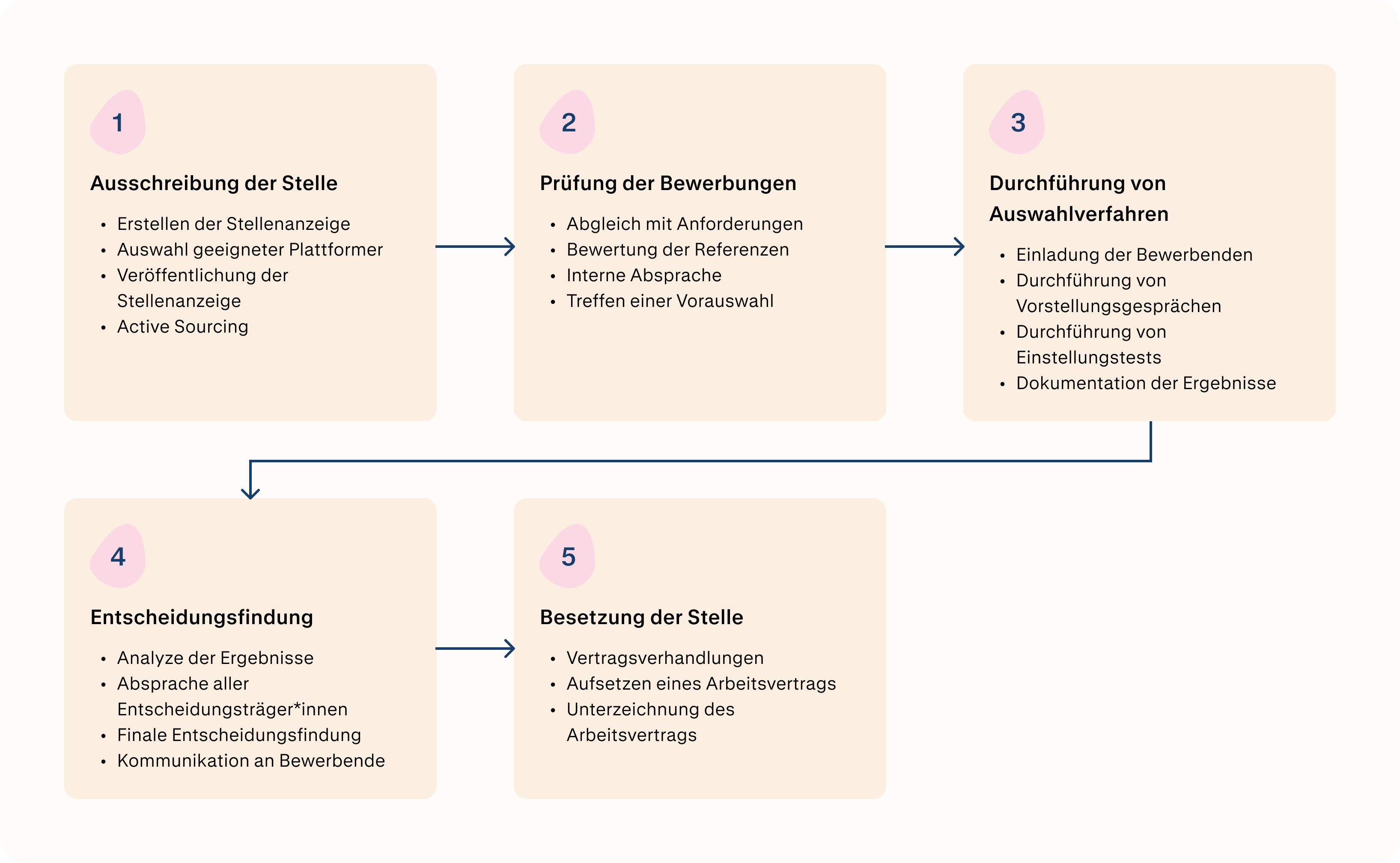
The time it takes to fill a position depends on both internal and external factors. When it comes to the speed of generating applications, the attractiveness of a company as an employer is relevant. Companies with a positive image are more likely to attract qualified candidates than organizations with a negative reputation. A strong employer brand encourages applicants to actively respond to job openings, leading to faster application submissions. The requirements for a position also influence the rate at which applications are received. The more specialized a position is, the smaller the pool of suitable candidates.
Once applications have been received, the efficiency of recruitment processes has a major impact on the duration of the subsequent stages. Well-structured workflows and clearly defined responsibilities ensure that all process steps can be completed quickly. The level of digitalization in applicant management and the complexity of the selection procedures are factors that influence the time required for recruitment. Externally, the primary impact is the economic situation on time-to-hire. During times of economic uncertainty or downturns, companies tend to be more cautious when filling open positions. For example, decision-making may be deliberately delayed if companies have concerns about their financial stability.
If a long time passes before a position is filled, it can have various negative consequences for companies:
Lower recruitment success: In a 2022 study commissioned by the Königsteiner Gruppe, individuals who had been through at least one application process in the last five years were surveyed about their experiences. 21 percent stated that they had turned down a job offer because the selection process took too long. The more time a recruitment process takes, the greater the likelihood that qualified candidates will drop out. Applicants are usually going through several application processes in parallel, allowing them to directly compare their efficiency. A lengthy process appears unprofessional, diminishes applicant interest, and increases the risk that they will choose competitors instead.
Deterioration of employer image: The duration of an application process can also negatively impact a company's employer branding. Applicants who find a process too long may share this experience within their network or on review platforms. If other potentially suitable candidates hear about these negative impressions, they may decide against applying to the company.
Loss of motivation among existing employees: A bottleneck resulting from an unfilled position must be covered by the existing team. This increases the workload for employees, which, depending on the extent, can lead to frustration, loss of motivation, or burnout. This can result in a higher turnover rate.
Poorer company performance: Vacancies can generally be compensated for by other employees for a certain period. However, if the team lacks the necessary skills for specific tasks, those tasks remain undone. This delays projects, which can hinder a company's progress. In the long term, this leads to a loss of efficiency and negatively impacts overall company performance.
A long time-to-hire can also result in financial losses for companies. Every unfilled position incurs costs, known as "cost of vacancy." These can be divided into two categories: direct and indirect costs.
Direct costs arise from measures taken to fill open positions. Depending on the platform, this includes the cost of posting job advertisements. If a vacancy remains open for a long time, ads may need to be posted multiple times or on additional paid platforms. Furthermore, internal personnel costs rise because processing more applications and conducting subsequent selection procedures and interviews requires additional time and resources. If external service providers, such as recruitment agencies, are hired to speed up the search for suitable candidates, this incurs additional costs.
Under indirect costs fall opportunity costs—the lost chances and potential profits a company could have generated had a position been filled in a timely manner. If projects are not completed due to a lack of staff, revenue losses may follow. Delays also negatively impact customer satisfaction and can reduce the number of new orders in the long term. Since the cost of vacancy is composed of many factors and a long time-to-hire can also lead to costs that only become apparent long after a position has been successfully filled, an exact calculation is hardly possible. Nevertheless, there is a formula that can be used to estimate these costs. In addition to the annual gross salary for a position, the number of working days per year, and the period during which a position remained vacant, the position's impact factor must be identified to calculate the costs incurred. For this purpose, jobs are roughly divided into three levels of importance. Level one applies to positions with little to no impact on company success, such as apprenticeships. Level two generally applies to specialists who have a moderate impact. Positions with a high impact on the company's bottom line are assigned to level three, which includes management roles. The impact factor is used as a multiplier in the formula for calculating the cost of vacancy:
(Annual salary : average working days per year) × impact factor × average time-to-fill = cost of vacancy
The ideal length of time-to-hire depends on the perspective. The requirements of applicants and companies do not always align. For applicants, the duration from the submission of their application is what matters most. The 2021/22 Candidate Experience study by Stellenanzeigen.de shows that fast processing and decision-making have a direct impact on applicant satisfaction. If the process takes a maximum of two weeks, the candidate experience is very high. With a processing time of up to four weeks, it drops slightly but remains positive overall. Once the duration exceeds four weeks, 20.6 percent of those surveyed feel the application process is too long.
For companies, it is a matter of finding a balance. A process that is too slow increases the risk of the aforementioned negative consequences. Nevertheless, all application steps must be carried out thoroughly, as a rushed process carries the risk of hiring someone who later proves unsuitable for the role. This can result in the need for another recruitment process to fill the position again. Furthermore, certain positions require more extensive competency assessments, such as case studies, than others. The optimal time-to-hire therefore varies depending on the position. However, a recruitment process should always aim to avoid unnecessary delays. It is also important to keep applicants informed about the expected duration and to notify them of any deviations.
There are many ways to shorten the time it takes to fill open positions. The following optimization approaches can be flexibly combined or implemented step-by-step, depending on a company's individual needs and resources:
Strategies to optimize application generation:
1. Optimize your career page: For many applicants, an organization's career page is the primary destination for information about open positions. It not only provides details on requirements and responsibilities but also offers a first impression of the company culture. A well-structured, informative page that provides authentic insights into the work environment can increase the volume of applications. The same applies to user-friendliness: if candidates can apply easily directly through the career page, potential barriers are minimized.
2. Improve employer branding: A company perceived as an attractive employer stands out from the competition. Through employer branding initiatives—such as effectively communicating an organization's unique selling points or career opportunities—you can generate greater interest among potential applicants.
3. Refine your target audience approach: To accelerate the recruitment process, the target audience for each position must be precisely analyzed and reached through the right channels. Furthermore, job advertisements should clearly communicate the required skills. A more targeted approach increases the compatibility of applicants with the advertised role. Unsuitable candidates can be filtered out early, which shortens the subsequent screening process.
4. Engage in active sourcing: Active sourcing involves proactively reaching out to qualified candidates, eliminating the need to wait for applications. This approach also allows you to specifically select talent that meets the requirements of the open position, ensuring a strong fit from the very beginning.
5. Build a talent pool: Building a talent pool is a long-term strategy for gathering potential candidates for future roles. This pool can include profiles of qualified applicants for whom no suitable position was available at the time of their initial application. As soon as a new position opens up, you can tap into this resource.
Strategies to optimize the application process:
1. Create a positive candidate experience: A strong candidate experience prevents qualified applicants from dropping out due to dissatisfaction during the hiring process. When candidates feel valued and well-informed, the process leaves a positive impression that they may even share within their own networks. The acceleration measures mentioned in the following points can help achieve a high-quality candidate experience.
2. Structure processes: Efficient and well-structured workflows are essential for accelerating the application process. Automating and digitizing manual steps helps reduce workloads and minimize potential errors. Additionally, it is advisable to set firm deadlines for each stage of the recruitment process. This not only improves planning but also ensures faster processing.
3. Improve internal communication: Streamlined communication channels also contribute to a better time-to-hire. Clear responsibilities and the internal use of digital applicant tracking systems, which provide a centralized management hub for all involved staff, lay the foundation for rapid processes.
4. Create transparency: Transparency is necessary to counter candidate uncertainty and reduce the risk of them dropping out due to delays. Open communication regarding which steps to expect in the selection process and how long they typically take builds trust. One way to promote transparency is by implementing dedicated online platforms for applicants. These allow them to view the status of their applications at any time, which also reduces the communication burden on HR departments.
As in almost every area of business, artificial intelligence (AI) is increasingly being used in recruitment. AI-powered tools help automate and streamline various stages of the application process. The use of AI in talent acquisition, also known as robot recruiting, can shorten time-to-hire, though it also faces criticism.
A key advantage of robot recruiting in terms of reducing time-to-hire is the ability to standardize the screening of applications and thereby accelerate it. AI can analyze resumes and other application documents and match them against job requirements. By processing large amounts of data, it can identify patterns that indicate which candidates are particularly well-suited for a position. Based on this, a shortlist of potential candidates is created and forwarded to the HR department. Since staff only need to review a filtered selection of applications, significant time can be saved. According to a 2022 Statista study, 48.7 percent of HR managers surveyed can imagine using AI for the pre-selection of potential candidates.
Subsequent scheduling of interviews or tests can also be automated. Communication with applicants can also be made more efficient through robot recruiting. Chatbots are capable of answering candidate questions in real time. This accelerates the flow of information between the company and the applicant, preventing talent from dropping out due to long wait times for feedback. In some cases, AI systems also conduct initial interviewsbased on standardized questions. The results of automated interviews are then evaluated by identifying speech or behavioral patterns, which allows for insights into a candidate's soft skills. This makes it possible to assess suitability in advance without tying up human resources. According to the Statista survey, however, only 9.5 percent of HR managers are currently considering using AI to directly approach candidates. Even fewer of those surveyed—just 1.6 percent—are considering using AI in the final hiring decision.
Overall, the use of AI in recruitment offers significant potential for shortening time-to-hire. The responses from the HR managers surveyed suggest that its use will remain limited for the foreseeable future, particularly in sensitive phases like the final selection decision. One reason for this is that human judgment, especially when assessing interpersonal skills, is still widely considered more reliable.
Candidates also have mixed reactions regarding the use of AI in recruiting. According to a 2022 study by the International University of Applied Sciences Bad Honnef, more than half of those surveyed view the inclusion of AI positively, particularly in the early stages of the recruitment process, such as drafting job advertisements, using chatbots, or pre-selecting candidates. 31.7 percent stated that AI accelerates the entire application process. At the same time, however, there is skepticism: 65.2 percent feel negative emotions at the thought of AI being used in the recruitment process. Acceptance decreases when AI is used in the later stages of the process, such as the final selection. Concerns among candidates include potential lack of transparency in decisions, data privacy violations, and less consideration of individual characteristics in the selection process.
To use AI effectively to reduce time-to-hire, companies should address candidate concerns and strive for a combination of human judgment and automated processes.
Long time-to-hire periods are not always caused by company processes or decisions. Often, the problem lies with the labor market itself. After all, there are not enough suitable candidates to fill all open positions. In industries heavily affected by the skilled labor shortage, vacancy durations increase accordingly. The bottleneck occupations with the 15 longest vacancy durations showed average values between 239 and 303 days in the period from October 2023 to September 2024. Measures to accelerate the acquisition of applications and the application process alone are not sufficient in these cases. Even if a recruitment process is made more efficient, few or no suitable applications will be received if qualified professionals are mostly already employed or are not available in sufficient numbers. Therefore, companies must additionally find strategies to expand the pool of workers they target. Only in this way can shorter vacancy durations be achieved again in bottleneck occupations.
One possibility is recruiting international professionals . However, this approach brings challenges that can also have a negative impact on time-to-hire. These include, among other things, the time-consuming recognition of international qualifications. The 2023 revision of the Skilled Immigration Act is intended to simplify the hiring process, however.
Another solution is the increased use of internal potential. Through further education and retraining programs, existing employees can be qualified for open positions. This reduces dependence on the external labor market while simultaneously strengthening employee retention by opening up career prospects within a company. According to the LinkedIn report "The Future of Recruiting 2023," 76 percent of recruiters believe that this form of talent development will be highly relevant for filling open positions over the next five years.
Optimizing time-to-hire is becoming increasingly important in times of skilled labor shortages. Companies are under pressure to make their recruitment processes more efficient in order to reduce costs and avoid losing qualified candidates to competitors. Among other things, more structured application workflows, the use of AI, and the development of a strong employer brand can be levers for filling open positions faster and positioning oneself well in a competitive labor market.
In bottleneck occupations, however, these optimization methods often reach their limits, as there is sometimes a complete lack of qualified candidates. The IW labor market projection for 2027 predicts that if the empirical trends of recent years continue, the skilled labor gap will widen by 2027 and spread to further professional fields. Companies must therefore increasingly rely on internal potential through training and further education measures. At the same time, the recruitment of international professionals in Germany is becoming essential to meet the growing demand.
Ultimately, only those organizations that both optimize their recruitment processes and actively expand their pool of potential candidates will likely be able to offset the effects of the skilled labor shortage on time-to-hire. The ongoing competition for talent requires organizations to react flexibly to the changing labor market—especially with regard to the growing skilled labor gap, which is expected to continue to shape the coming years.
In einem unverbindlichen Gespräch tauschen wir uns gerne mit Dir zu Deinen HR-Themen aus und zeigen Dir, wie wir Dir bei diesen helfen können.
Florian Klages | Managing Partner


Employer branding can support your company in its search for personnel. What are the benefits, and how do you develop a suitable strategy?

People analytics can contribute significantly to achieving corporate goals. In which areas can it be applied?